
When Unions Turn Inward
The Silence Rule
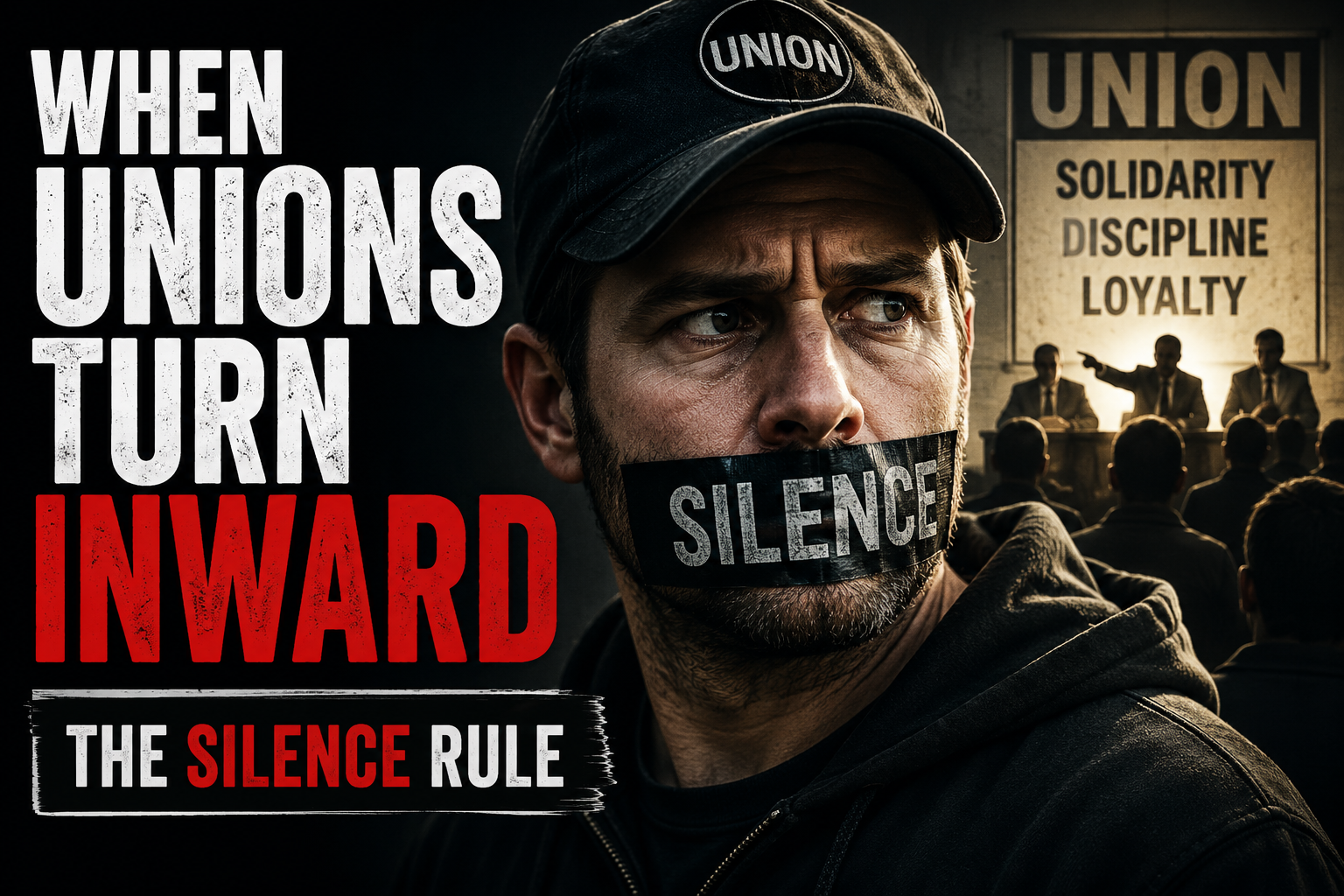
The Silence Rule
This article exposes what happens when a union turns inward and starts treating member dissent as a threat instead of a warning signal. It argues that the real danger inside labor is not disagreement, criticism, or difficult conversations, but the silence rule that teaches members to protect their livelihoods by staying quiet when leadership fails them. Through a deeply personal account, the article shows how family, solidarity, and procedure can become tools of control when an insulated institution prioritizes its own stability over the workers it exists to represent. The point is not to destroy unions, but to tell the truth: a union card should be a source of power, not a leash, and any labor institution that makes honesty a career risk has already started protecting the machine instead of the members.
Beyond The Workforce
Issue 29
By David Thomas Graves
The Silence Rule
There is one thing you are not allowed to say inside a labor union, unions fail their own members. You can say the boss is a liar. You can say management is predatory. You can say the company is cheating. You can say the politicians are useless. You can say the system is rigged.
But say the union is failing you, failing the people paying for it, working under it, counting on it, and the air changes. You didn’t walk into a debate. You walked into a rule you weren’t told existed.
A union does not need to kick you out to control you. It only needs to threaten your ability to work. That’s the part outsiders miss. They assume internal union conflict is drama. Personality wars. Ego. Petty politics. No. The real thing is colder.
In too many modern unions, dissent isn’t treated like disagreement. It’s treated like a risk to institutional control. And once your voice gets classified as a risk, you don’t get argued with.
You get managed.
The promise I was sold
When I joined my union, I was sold something powerful. Family. Support. Protection. Voice. I was told it was my organization. I’d be heard. I’d have a say. Disagreement wouldn’t make me an outsider. And I believed it. I remember walking out of my first union meeting and telling my wife at the time, I have a family. I meant it. I thought I’d found the thing workers rarely get in this economy: a structure that holds.
So I leaned in. I tolerated the bureaucracy. I accepted the friction. I told myself it was the price of building power. I tried to improve it. I tried to expand it. I dealt with internal politics because I believed the mission was bigger than the mess.
Then I learned the real contract. The promise comes with conditions. It works when you’re useful. It works when you stay inside the approved lane. It works when your voice doesn’t threaten leadership’s hold.
The moment your voice threatens leadership’s hold, the promise doesn’t get debated. It gets rewritten.
Quietly. Procedurally. With a smile.
The day the story broke
There was a strike in Los Angeles. Not my union. Another union. But their strike hit our ability to work. And when you’re collateral damage in a fight you didn’t vote for, slogans stop feeding your family real fast.
People I knew started calling me because they didn’t know what to do. Rent due. Mortgage due. Bills stacking. No paycheck coming. The kind of fear that doesn’t sound like politics. It sounds like panic. It sounds like somebody trying to keep a roof over their kids while the calendar keeps moving.
Some of them sounded like they were at the edge. Not stressed. Not concerned. At the edge. So I brought it to union leadership and expected one basic thing, tell the truth about what was happening to our members.
I wasn’t asking them to torch another union. I wasn’t asking them to break solidarity like it was a hobby. I wasn’t asking them to hand management ammunition. I wanted a simple statement of reality, this labor action is hurting our people, and we’re not going to pretend it isn’t.
They wouldn’t.
The leadership line was simple and absolute, it’s always the employer’s fault. Never the working class. Never another union. Never the movement. That stance sounds principled until you see what it really is. It’s a loyalty script. And scripts are not representation. Because my members were getting crushed and leadership’s priority wasn’t the members in front of them. It was the narrative. It was the posture. It was staying clean inside the walls while workers were getting dirty outside them.
So I said what people wanted to say but were afraid to say. I said it publicly.
And the response proved the silence rule was real. Members messaged me to say thank you for saying what they were scared to say. Some told me they didn’t know they were allowed to speak like that.
That is the sickness in one image, a movement that depends on speech to organize workers, training workers to fear their own speech.
What happens when you break the rule
People think unions are brutal outward, against employers. The truth is uglier, unions can be brutal inward too. And they don’t have to come at you like a villain to hurt you. They can come at you like process.
It looks like standards. It looks like internal discipline. It looks like procedure. It looks like meetings where the rules become a weapon. It looks like order being used to produce obedience. It looks like professionalism being used to train people to keep their heads down.
After I spoke up, the union didn’t come at me like a family. It came at me like an enemy. Slow. Painful. Methodical.
Not one clean confrontation. Not one honest debate. A drawn-out campaign to isolate, weaken, and remove. The same way a company squeezes out a worker without firing them, cut oxygen, cut access, poison reputation; and let the person exhaust themselves trying to prove they still belong.
Here’s the core lesson.
A union doesn’t need to take your card tomorrow to control you today. It only needs to make you believe it can. Once you believe your livelihood is on the line, you start acting like most rational adults act when the risk gets existential.
You shut up.
And that’s the silence rule, honesty made expensive. In real life it looks like this, your reputation gets quietly poisoned. Information stops flowing to you. People who used to agree with you stop standing next to you.
Then somebody says the sentence that explains the whole machine:
They don’t trust you. Nothing you say, even if it’s the best idea in the world, will ever be heard.
I was told directly, you will never advance in this organization. You will never have influence here. You’re done.
All because I said something leadership didn’t want said. All because I put the membership before leadership.
That is not union democracy. That is institutional self-defense.
And every member watching learns the same lesson: stay in line, support bad strategy, support bad negotiation, support bad leadership, or one day you’ll be the target.
The lie inside family
The union is family language is powerful because it’s half true. People do take care of each other. People do sacrifice. People do show up. People do risk things together that they would never risk alone.
But when family means don’t embarrass leadership, it stops being family.
It becomes control.
And once that control sets in, members get treated less like independent workers and more like dues flow that has to be managed. The institution starts behaving like the member exists to stabilize the union, instead of the union existing to increase member power.
Sometimes it’s conscious. Sometimes it’s just reflex. Either way, it produces the same outcome, a system that punishes internal honesty while preaching solidarity.
Why this inversion happens
A lot of people want a simple explanation: bad leaders. Fine. Sometimes that’s true. But if you stop there, you miss the engine. The engine is insulation.
In most parts of your life, if an institution fails you, you can walk away and find another one. In a union labor market, walking away can mean losing benefits, losing pension credit, losing your network, losing job access, losing years of career gravity.
Sometimes leaving doesn’t mean switch providers. It means exit the trade. That changes the internal pressure system. It means unions don’t face normal correction when leadership fails. Leadership can become insulated. Culture can become insulated.
And when an insulated institution gets challenged, it reacts like insulated institutions react.
It treats the critic as the threat. Not the failure.
Fixing failure is hard. Silencing the critic is easier.
That is not leadership. That is management. And management is not power.
What this does to workers
This dynamic poisons unions because it trains members to lie. Members aren’t weak. They’re rational. When honesty threatens your ability to earn a living, most people protect their paycheck. They protect their kids. They protect their housing. They protect their healthcare.
So they stay silent.
And silence gets interpreted as consent. Leadership tells itself, we’re unified.
Members know, we’re afraid. That’s how unions drift. Not through one dramatic betrayal. Through a culture that punishes the signals that could have corrected the course. And once a union stops learning from its own members, it stops adapting. It keeps doing the same thing over and over, expecting a different result.
The central turn
Here is the line I learned, the moment you prioritize the member over the institution, the institution reclassifies you.
You are no longer internal. You are a threat. And once you become a threat, the union will treat you with the same hostility it reserves for employers.
That’s the inversion.
A union is supposed to concentrate power against employers. When it concentrates power against its own members, it has inverted. And that inversion is how a worker institution turns on its own members.
Political machines don’t protect workers. They manage them. This is not a call to burn unions down.
It’s a refusal to pretend. A union card isn’t supposed to be a leash. If the system makes truth-telling a career risk, the system is already broken.
You don’t abandon it.
You take it back.
© David Thomas Graves 2026