They are keeping the Checkpoint Open and the Paychecks Closed
This Was Never Just About the Checkpoint
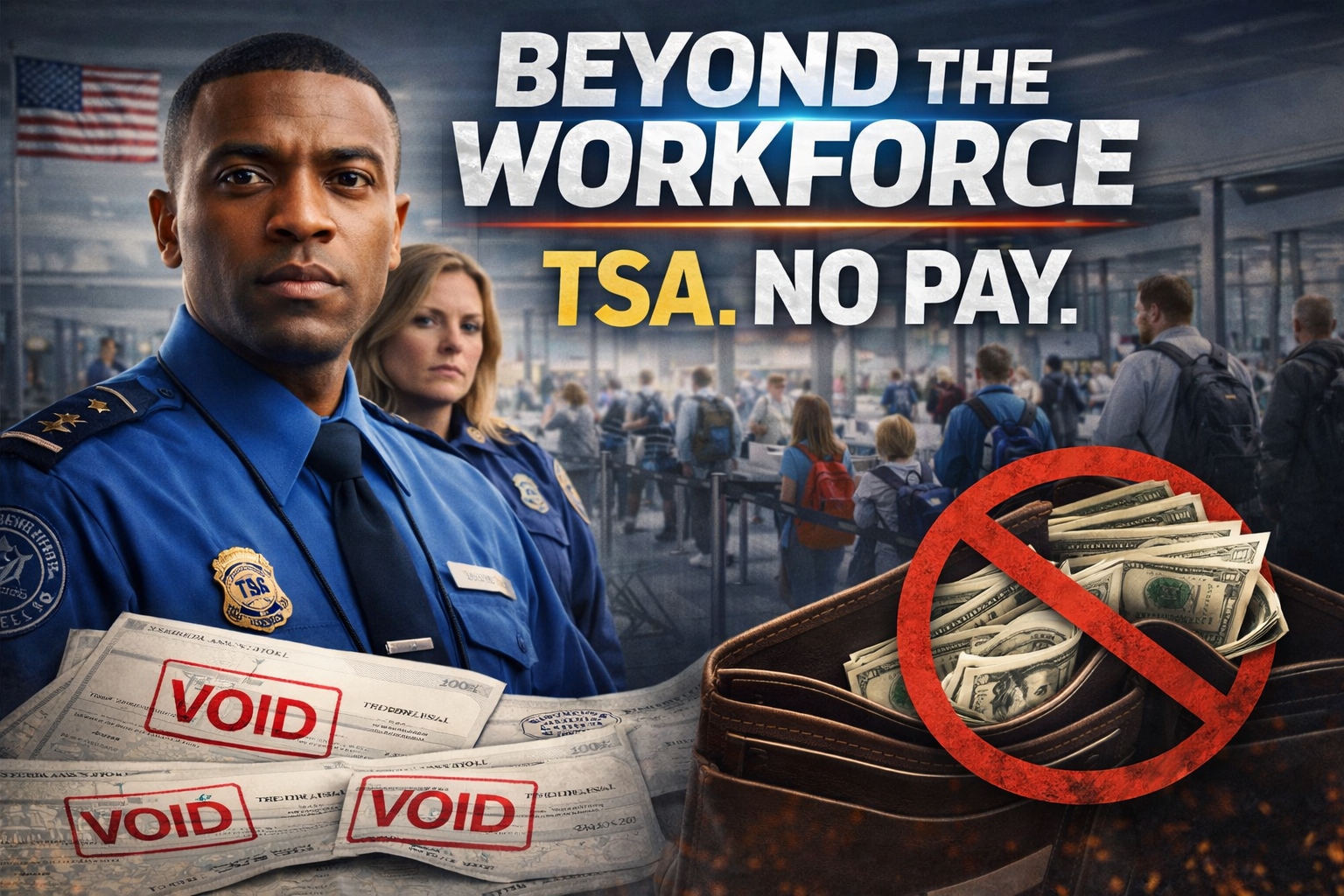
Beyond The Workforce
Issue 24
By David Thomas Graves
This Was Never Just About the Checkpoint
When most Americans hear “Transportation Security Administration,” they picture the person at the metal detector telling them to take off their shoes. That picture is too small. The Transportation Security Administration is not just the face at the lane. It is the Transportation Security Officers screening passengers, baggage, and cargo. It is the Federal Air Marshals securing civil aviation and the wider transportation domain. It is the mission-support staff in intelligence, engineering, management, accounting, human resources, and operations who keep the system running behind the scenes. The agency’s own careers materials describe those security, law-enforcement, and mission-support tracks plainly.
And this was never only an airport-line story. In written testimony to the House Committee on Homeland Security, Ha McNeill said the Transportation Security Administration screens around three million passengers on peak days and that more than 95 percent of its workforce, more than 61,000 people, is deemed essential and must keep working during a shutdown. The same hearing record also showed how wide the damage ran across the Department of Homeland Security. The Cybersecurity and Infrastructure Security Agency said proactive services, planning, and outside engagements were being paused or scaled back because workers were limited to excepted functions and were working without pay. The United States Coast Guard testified that for 85 of the last 176 days it had been without the funding necessary to operate and pay its people. This was the operating labor spine of homeland security being treated like a bargaining chip.
These are not giant-salary jobs built for people sitting on half a year of savings. Official federal job postings show Transportation Security Officer starting pay varies by airport and locality. One current posting in Grand Forks starts at $50,716 and tops out at $62,528. The Transportation Security Administration also tells recruits that new officers can climb to as much as a 67 percent increase over their starting base salary across five years. That is a career ladder, not a magic shield against missing weeks of income. These are working paychecks. The kind that keep households stable when they arrive on time and blow holes in them when they do not.
That is what made this whole spectacle so ugly. The Office of Personnel Management says employees performing excepted work during a lapse in appropriations can be required to keep working but cannot be paid until the lapse ends. The Government Accountability Office says agencies generally may not spend money during a shutdown, including on salaries. That is the structure. That is how you get the checkpoint open and the paycheck closed.
And that is why this story should not be flattened into the usual stupid argument about whether this was Donald Trump’s fault or Chuck Schumer’s fault. Individual decisions mattered. Specific votes mattered. But the bigger truth is nastier: this was Washington working exactly the way Washington works. Multiple choke points. Multiple leverage plays. Multiple factions trying to squeeze concessions out of each other. And the workers doing the actual job got trapped in the middle because that is what this system does when it fails. The Senate’s cloture rules require three-fifths support to cut off debate on these motions. In practice, that means 60 votes become the gate. Add a partisan House, a partisan Senate, a short-term funding patch, and a political culture that treats labor as leverage, and the people on the floor are the ones who get hit first.
Congress Has Run This Play Before
This is not a freak event. It is a governing method.
Congress and presidents of both parties have been using funding lapses to turn federal workers into pressure points for decades. The House historian’s shutdown timeline records the 1995 funding lapse, the 2013 shutdown, the January 2018 shutdown, the 34-day shutdown that began in December 2018 and ran into January 2019, the 43-day lapse in the fall of 2025, and the January-February 2026 lapse that ended with the temporary stopgap this fight grew out of. In 2013, the Government Accountability Office said about 850,000 federal employees were furloughed for part of the shutdown. In late 2018 and early 2019, the House historian records a 34-day lapse. The issue changes. The hostage model does not.
And yes, Washington partially cleaned up one piece of that damage after 2019. The Office of Personnel Management says the Government Employee Fair Treatment Act guarantees retroactive pay for furloughed employees and for employees required to perform excepted work during a lapse in appropriations. But that law changed the cleanup, not the coercion. Workers still have to do the work first and wait for the political class to decide when the money is allowed to move. Retroactive pay is not the same thing as timely pay.
That is the real history here. Congress almost never stands up and says, cleanly and honestly, “we are cutting workers’ pay.” It does something more cynical and more respectable-sounding. It withholds appropriations. It blocks narrow fixes. It writes temporary patches that preserve the fight. Then shutdown law does the dirty work. Essential workers keep working. The paycheck stops. The pressure builds. And later, once enough pain has been inflicted, Washington congratulates itself for restoring money it never should have withheld in the first place.
Washington Built the Fuse on Purpose
The current fuse was built in public.
Before the shutdown story ever reached the airport, House leadership had already built the trap. On January 22, the House Rules Committee reported the floor rule by a 9-4 vote. That rule treated the two spending bills very differently. The broader package got a structured amendment process. The Department of Homeland Security bill got a closed rule. Then House Resolution 1014 went further. Section 4 said the clerk could not even send the broader package to the Senate until the Department of Homeland Security bill had passed. Section 5 said the text of titles I through V of the Department of Homeland Security bill would be folded into the larger package as Division H. In plain English: House leadership tied the larger funding package to the Homeland Security fight on purpose and put the Homeland Security bill in the tighter procedural box. The rule passed 214-213. The Department of Homeland Security bill passed 220-207. The broader package passed 341-88. Washington had room to fund government broadly. It chose to make Homeland Security, and the workers trapped inside it, the pressure point.
That setup was not accidental. On January 22, Katherine Clark’s floor remarks attacked the Department of Homeland Security bill because it did not impose the immigration-enforcement guardrails Democrats wanted. Then, on February 4, Hakeem Jeffries and Charles Schumer formally wrote to Mike Johnson and John Thune saying any Department of Homeland Security funding agreement needed restrictions on Immigration and Customs Enforcement, including judicial warrants before entering private property, no masks, visible identification, limits on enforcement near sensitive locations, restrictions on racial profiling, use-of-force rules, and body-worn cameras. That is the documentary record. Worker pay was not treated as a separate sacred obligation. It was deliberately fused to a larger enforcement fight.
Then the Senate did what Washington always does when it wants to look busy without actually solving the problem. On January 29, it failed to invoke cloture on the larger appropriations package. On January 30, after spending the day on amendment votes about refugee assistance, earmarks, and other appropriations issues, it passed the amended package 71-29. But that package did not end the Department of Homeland Security fight. It funded the rest of government while extending Department of Homeland Security funding only through February 13. The House concurred in the Senate amendments 217-214 on February 3, and the White House announced that the president signed House Resolution 7148 into law that day. Washington did not solve the problem. Washington wrote itself a shorter fuse.
That matters because it destroys the fake surprise that came later. Nobody stumbled into this deadline. Congress created it knowingly, voted for it knowingly, signed it knowingly, and left the people doing the work standing exactly where the explosion was going to happen.
The Senate Kept Finding Time for Everything Except the Workers
When the February 13 deadline hit, the Senate did not act like a body under emergency labor conditions. It acted like itself.
On February 12, it failed to invoke cloture on the motion to proceed to the Department of Homeland Security bill, 52-47. But that same day it also passed a joint resolution disapproving a District of Columbia tax measure, confirmed Coast Guard promotions by unanimous consent, agreed to the State of the Union joint-session resolution by unanimous consent, entertained a separate unanimous-consent fight over sanctuary-city legislation, and then adjourned with only pro forma sessions scheduled until February 23. The Senate failed the workers, kept the calendar, and went home.
The House kept its own calendar too. The public House schedule still showed long stretches with no scheduled House vote days across late February and mid-March while Transportation Security Administration workers remained unpaid. And by March 23, even the travel industry was mocking the spectacle. The U.S. Travel Association called it “a paid vacation for Congress” while airport security workers faced another zero-dollar paycheck. That criticism landed because it was true. The institution preserved its own calendar discipline while the workers had no such luxury.
Then the Senate came back and kept proving the point. On February 24, it reconvened, had Tim Kaine read George Washington’s Farewell Address, prepared for the State of the Union, and then failed again on Department of Homeland Security funding, 50-45. On March 5, it passed the Children’s Online Protection Privacy Act by unanimous consent before failing again on Department of Homeland Security funding, 51-45, and adjourning until March 9. This body was not frozen. It was choosing, day after day, what ranked higher than worker pay.
March 12 made the pattern impossible to miss. The Senate passed the Housing for the 21st Century Act 89-10. Then it failed again on Department of Homeland Security funding, 51-46. Then senators traded objections over narrower fixes for the Transportation Security Administration, the Coast Guard, the Cybersecurity and Infrastructure Security Agency, and a two-week continuing resolution. Then, during wrap-up, the Senate adopted a resolution celebrating the 175th anniversary of the Young Men’s Christian Association and adjourned until March 16. The workers kept missing checks. The Senate kept clearing other business.
It got worse. On March 20, while wrapped up in the Save America Act, the Senate failed cloture again on Department of Homeland Security funding, 47-37, with 16 senators not voting. On March 21, it first voted on a Tuberville-Blackburn amendment tied to the Save America Act and only after that turned to the Schumer effort to advance Transportation Security Administration funding, which failed 41-49. On March 22, it passed other bills and resolutions by unanimous consent, moved forward on the nomination of Markwayne Mullin to be Secretary of the Department of Homeland Security, and objected to a request that would have withheld senators’ pay during a shutdown. On March 24, it confirmed a Department of Justice nominee, recessed for weekly caucus lunches, handled the Save America Act and Iran war-powers fight, and only then moved back toward Department of Homeland Security funding. Fish, sea turtles, caucus lunch, nominations, and side fights all found room on the schedule while frontline workers kept working for free.
The Democrats’ Labor Myth Breaks Here
This is the part Democrats are not going to like.
If you call yourself the party of labor, there has to be a line you will not cross. Frontline workers missing paychecks for weeks should be that line.
The documentary record does not show that line. It shows Democratic leadership formally tying Department of Homeland Security funding to immigration-enforcement guardrails: judicial warrants before entering private property, visible identification, no masks, body cameras, sensitive-location restrictions, racial-profiling prohibitions, and use-of-force limits. Those demands may be defensible on their own terms. That is not the point. The point is that once worker pay was allowed to live inside that bargaining package, worker pay stopped being sacred and became negotiable. A real labor politics would have forced those fights onto a separate track.
And yes, Senate Democrats later tried a narrower route for Transportation Security Administration funding. But timing matters. That move came on March 21, after weeks of unpaid labor, after repeated Senate failures, after the aviation system was already straining, and after workers had already been forced to absorb the cost. A late narrower fix does not erase the earlier willingness to let worker pay remain inside a larger enforcement standoff.
The Republicans’ Business Myth Breaks Here
Republicans do not get a pass either.
If you call yourself the party of business, stability, and economic common sense, you do not let the aviation system absorb this kind of damage while defending partisan leverage.
By March 15, the chief executives of the major airlines were telling Congress directly that 171 million passengers were expected during the spring travel season, that waits of two, three, and even four hours had already been reported, and that action was needed immediately. On March 17, the airport associations warned that unexcused absences among Transportation Security Officers had tripled to a nationwide average above 10 percent, with some airports above 50 percent. On March 19, the U.S. Travel Association said Congress was leaving airport security officers “out in the cold” while travelers waited for hours. That is not a left-wing critique. That is the travel economy telling Washington it was damaging a critical national system in real time.
And the politics stayed small. The airport associations warned on March 17 while Congress was still preserving its own recess structure. On March 23, the U.S. Travel Association openly blasted the idea of Congress preparing to leave town while airport security officers stared at another zero-dollar paycheck. If you really believe in uninterrupted commerce and operational stability, you do not do this. What Republicans defended here was not business continuity. It was partisan leverage dressed up as principle.
What the Damage Looked Like
The human cost stopped being abstract a long time ago.
In written testimony for the March 25 House Committee on Homeland Security hearing, Ha McNeill said more than 61,000 Transportation Security Administration employees were essential and required to work without pay. She said agency employees had already worked 87 days in fiscal year 2026 without receiving pay on time and that by March 27 the government would be at nearly $1 billion in payroll that had not been paid in a timely manner. That is not a symbolic inconvenience. That is a government-manufactured cash-flow crisis dumped onto working people.
McNeill also laid out the operational damage in plain English. Since the February funding lapse began, the Transportation Security Administration had already lost around 460 officers. Daily callout rates had risen from 4 percent before the shutdown to 11 percent nationwide, with multiple airports above 40 percent and above 50 percent. Spring-break travel was running about 5 percent above the prior year while some airport wait times had already exceeded four and a half hours. The labor pain and the system pain were the same story.
The personal details were worse. McNeill testified that officers were reportedly sleeping in their cars to save gas money, selling blood and plasma, taking second and third jobs, receiving eviction notices, losing childcare, missing bill payments, damaging their credit, defaulting on loans, and even failing to qualify for loans meant to ease the burden. That is what Washington converted its procedural fight into. Not just inconvenience. Not just a partisan headline. A direct assault on the financial stability of ordinary workers who had already been ordered to keep showing up.
And this was not even the first time the same workforce had been chewed up by the same culture. McNeill said that during the 43-day shutdown in October and November 2025, around 1,110 Transportation Security Officers separated from the agency, a 25 percent increase over the same period in 2024. Washington did not create a one-off crisis in March. It had already been grinding this workforce down through repeated instability.
The System Protected Some Power Better Than It Protected the Workers
There is another ugly layer here.
Transportation Security Administration workers were trapped inside shutdown no-pay rules. At the same time, Public Law 119-21 created a separate immigration-and-law-enforcement funding part that specifically appropriated money for United States Immigration and Customs Enforcement through 2029, including money for hiring, training, and retention bonuses. And the Office of Personnel Management’s post-2019 shutdown guidance makes a related distinction clear: employees funded through an independent source are not treated the same way as workers directly affected by a lapse in annual appropriations. The clean point here is not a paycheck rumor. It is a funding-architecture point. The workers screening passengers and bags were still exposed to shutdown no-pay rules while other enforcement functions sat inside different statutory streams. That is not a neutral design.
Then Washington found an even darker workaround. Houston Airports told travelers that federal Immigration and Customs Enforcement agents were supporting operations at George Bush Intercontinental Airport and William P. Hobby Airport during the staffing crisis and warned that wait times at George Bush Intercontinental could exceed four hours. Senator Ruben Gallego demanded answers from the Department of Homeland Security the same day about the deployment of Immigration and Customs Enforcement agents to major airports, including Phoenix Sky Harbor. So yes, the absurdity was real: a political fight built in part around immigration-enforcement demands helped create a staffing crisis that was then being patched, at least in part, with immigration agents. That is Washington swamp politics, plain and simple.
This Was Washington Versus Workers
That is the real narrative behind this event.
Not that one side was pure and the other side was monstrous. Not that one politician’s name explains it all. But that American politics, as currently structured, is fully capable of watching the harm happen in real time, understanding exactly who is paying for it, and doing the same ridiculous dance anyway. The House built the trap. The Senate kicked the problem down the road. Democratic leaders made worker pay part of a larger immigration-enforcement fight. Republicans defended partisan routes and let the aviation system absorb the cost. Both chambers protected their calendars. The workers kept working.
That is why the old myths should die here.
If Democrats were really putting labor first, frontline pay would have been the firewall. If Republicans were really putting business first, uninterrupted airport operations would have been the firewall. Neither firewall held. What held was the Washington instinct to preserve leverage, preserve the talking point, preserve the factional narrative, and dump the cost downward. The airport security officer kept working. The passenger kept waiting. The airlines kept absorbing the disruption. And the people in charge kept calling that politics.
A serious country would fix this in one sentence: if the government declares a worker essential enough to keep showing up during a lapse in appropriations, that worker gets paid automatically and continuously, no matter how stupid Congress decides to be. Fight over immigration policy. Fight over warrants, masks, body cameras, voter legislation, and enforcement standards. Fight over all of it if you want. But do not make the person holding the line at the airport finance your dysfunction with rent money and groceries. The checkpoint should never stay open while the paycheck disappears.
That is the story here.
Not a red-team story. Not a blue-team story. A Washington story. And workers should read it exactly that way.
© David Thomas Graves 2026
This is not a Republican failure or a Democratic failure. It is Washington using workers as leverage.
Washington keeps airport security running while forcing the workers who hold the line to do it without pay, and that is the real scandal at the center of this fight. This is not a story about one party failing harder than the other. It is a story about a political system so addicted to leverage that it treats essential workers like bargaining chips, fuses their paychecks to partisan warfare, and then acts surprised when the damage spreads from family budgets to the national travel system. The article argues that the checkpoint should never stay open while the paycheck disappears, because the moment a government demands labor without guaranteeing timely pay, it stops looking like leadership and starts looking like betrayal.