Spirit Was Infrastructure. Washington Treated It Like a Talking Point.
Beyond The Workforce
Issue 27
By David Thomas Graves
Spirit Was Infrastructure. Washington Treated It Like a Talking Point.
Spirit’s shutdown hit me harder than I expected.
And it's not because I loved the product. The seats weren’t built for comfort. There were no frills, no lounge, no little performance of premium. Spirit wasn’t trying to be your lifestyle brand. It was trying to be a bus with wings.
And for a huge portion of the workforce, that is exactly what the country needs.
I moved my family out of California because the math stopped working. I make a strong income by national standards. Still didn’t matter. In the Los Angeles orbit, you can be doing well and still feel like you’re treading water in concrete boots.
In the city I left, $150,000 to $180,000 a year can buy you a two-bedroom condo if you’re lucky. Summer electricity bills can look like rent. Car insurance can look like a second car payment. Gas can look like a monthly penalty. And then there are taxes, money that disappears before you touch it, before you invest it, before you pay down debt, before you build anything. Call it a contribution, if you want. For workers it’s a subtraction. It’s reduced cash flow and reduced future.
So we made a choice that more workers are making every year; keep the job market, leave the cost structure.
We moved to Tennessee. But my work didn’t move with me. My work was still in Los Angeles.
That meant I had two options. I could move my family two or three hours outside L.A. and turn my life into a daily endurance test. Or I could build a stable home base in a cheaper state, then commute back into the expensive job market when I needed to, economically, without setting my life on fire.
The second option only worked because Spirit existed.
Spirit let me get from Tennessee to Los Angeles for under $70 a flight on a regular basis. That is not cheap travel. That is labor mobility. That is a worker’s ability to access opportunity without taking on debt for the privilege.
That is infrastructure.
And in May 2026, Spirit began shutting it down. All flights have been cancelled, the company said. Effective immediately. No soft exit. No gentle landing. Just a hard stop.
The country is treating this like a quirky airline story. The “haha Spirit seats” story. The “budget carrier goes bust” story.
That’s the wrong story.
Spirit wasn’t a joke. Spirit was a pressure valve in a fractured labor market. And Washington treated that valve like a talking point.
Spirit didn’t exist to make business travelers happy
Spirit existed to make the modern labor market possible for people who live on tight margins and move where the work is.
The rideshare driver, chasing a seasonal surge in another city. The independent contractor following a contract. The stagehand, the touring tech, the production freelancer who lives project to project. The traveling nurse. The refinery contractor. The construction worker. Families trying to find a way to keep the family in a cheaper home base while the work is in a high-cost metro area.
And yes, public servants, too.
There are firefighters and police officers serving cities they can’t afford to live in anymore. That reality isn’t political. It’s math. Some of them commute long distances because the housing near the job is priced like a gated community.
When you remove the cheapest mobility option, you don’t just raise ticket prices. You harden the labor market. You shrink worker range. You reduce opportunity, not as a theory, but as a practical limit.
A worker who can move has leverage. A worker who can’t is trapped. Spirit was not a luxury. It was a ladder.
The lie America tells itself every time a system breaks
Every time something like this collapses, you hear the same line, delivered like wisdom:
This is the free market.
No.
This was politics colliding with private infrastructure, and workers eating the cost.
Spirit didn’t just fail. Spirit got boxed in, then hit with a fuel shock it couldn’t survive.
That is not a morality play about airline management. That is a mechanism. And the mechanism has names.
Spirit wasn’t a brand. It was fare discipline.
When the Biden Department of Justice sued to block JetBlue’s acquisition of Spirit in March 2023, Attorney General Merrick Garland framed Spirit as essential to keeping fares down, especially for people who rely on ultra-low-cost carriers to fly at all.
That wasn’t labor rhetoric. That was the government describing a market function; Spirit forced price discipline onto routes where it operated.
Senator Elizabeth Warren also pushed this direction. Her office urged the Department of Transportation to use its authority to scrutinize airline consolidation, including JetBlue-Spirit, framed as a consumer harm issue.
Then the deal got blocked in court. JetBlue terminated the transaction. And the DOJ leadership celebrated the outcome as a win for travelers who deserve lower prices and better choices.
Here is the part Washington refuses to say out loud; Washington claimed it was protecting low-fare competition by blocking Spirit’s merger.
Then Spirit disappeared anyway.
So now we get the worst possible outcome: a dead carrier, job losses, and missing fare discipline, without even the clean story of the market decided.
That’s the trap state, you block the exit, then pretend the collapse is purely the company’s fault.
Yes, Spirit had problems. Debt. Thin margins. Post-pandemic turbulence. A balance sheet that did not leave room for mistakes.
But if you are going to block an airline’s strategic exit in the name of protecting low-cost competition, you do not get to shrug when the low-cost competitor dies.
You own the downstream effects. You own the workers. You own the routes. You own the mobility loss.
You don’t get to claim victory on Tuesday and innocence on Friday.
Fuel isn’t a cost line. It’s survival.
Spirit itself told you what killed it.
In its wind-down announcement, Spirit said the material increase in oil prices and other pressures hit the business so hard that, with no additional funding, there was no choice but to begin the wind-down.
Spirit’s CEO also said that in March 2026 the company had reached an agreement with bondholders on a restructuring plan that could have allowed Spirit to emerge as a going concern, until the sudden and sustained rise in fuel prices made that path impossible.
Spirit disclosed, in its own quarterly reporting, that Gulf Coast jet fuel pricing is the basis for a substantial majority of its fuel consumption, and that a hypothetical 10% increase in average fuel price would increase fuel expense by roughly $109 million. It also disclosed it had no outstanding jet fuel derivatives and hadn’t engaged in fuel derivative activity since 2015.
Translation: when jet fuel spikes, you don’t get a rough quarter.
You get a viability event.
The Trump war shock hit jet fuel like a hammer
On February 28, 2026, President Donald Trump ordered operation Epic Fury, major combat operations.
You can argue the merits of that operation. You can argue strategy. You can argue geopolitics.
But you cannot pretend it was a neutral market event.
When you launch major combat operations in and around a region tied to global energy flows, you are not watching markets.
You are moving them. So jet fuel prices moved. Gulf Coast jet fuel prices pushing into the $4-per-gallon range through April into early May 2026.
The Transportation Department reported in early May that U.S. airlines’ jet fuel spending and per-gallon costs jumping sharply in March 2026.
So the story isn’t “Spirit got unlucky.”
The story is; Spirit got pinned by policy, then hit by volatility it couldn’t absorb.
First box: the merger exit was blocked.
Second box: the fuel shock arrived anyway.
That’s how modern collapses happen. It’s not like a movie explosion. Like a trap closing.
We’re an oil-producing nation isn’t a shield. It’s a responsibility.
The Trump administration did take at least one stabilization action; the Department of Energy initiated emergency Strategic Petroleum Reserve exchanges as part of an international effort to stabilize supply.
But even that dramatic action didn’t stop jet fuel from spiking high enough to break fragile firms that were already boxed in.
If the U.S. government is going to create geopolitical shocks, it has to treat worker-facing infrastructure as part of readiness, not as collateral damage to be cleaned up afterward.
Because when you don’t protect the infrastructure, you don’t punish a company. You punish the people who rely on the tool.
The cleanup theater: price caps after the collapse
After Spirit began winding down, the Trump Department of Transportation put out an official release.
Secretary Sean Duffy blamed Joe Biden and Pete Buttigieg for blocking the JetBlue-Spirit merger in 2024, calling the situation, yet another mess, inherited from their radical policies.
Then, in the same release, Secretary Duffy described coordinating with major airlines to cap ticket prices for displaced Spirit customers, reduce fares on high-volume Spirit routes, and create job pathways for Spirit employees.
Read that slowly.
The government and the industry can coordinate price caps after the damage is done. They can coordinate special fare windows. They can coordinate job pipelines.
But when the fuel shock was hitting, when the system needed protection upstream, we got exposure, not insulation.
That’s not free enterprise. That’s political choice, followed by PR mitigation. And it is always workers who pay the spread.
This is what 17,000 jobs looks like when you stop romanticizing it
Spirit’s shutdown isn’t a chart. It’s people.
It’s thousands of workers losing a job that had a wage structure, a schedule structure, and in many cases a union structure, pilots, flight attendants, mechanics, dispatchers, ramp, gate, customer service, and everyone around them.
The Air Line Pilots Association called the closure a devastating blow to more than 2,000 ALPA pilots and thousands of other workers, and noted pilots had made major concessions trying to keep the airline alive.
The International Association of Machinists said workers shouldn’t be last in line in bankruptcy and called for full severance, back pay, and benefits owed.
And then there’s the second ring of damage, the workers nobody counts because they aren’t on payroll spreadsheets the way Washington likes.
Independent contractors and gig workers who used Spirit to move between cities when the work moved.
Families who used Spirit to keep a cheaper home base while working in an expensive market.
Workers who used Spirit as a mobility tool to make a fractured labor market livable.
Spirit wasn’t just an employer. Spirit was an option. And in a modern economy, options are power.
The part Washington refuses to own
If Democrats want to block consolidation, they need to own what happens when the targeted firm collapses anyway. Merrick Garland’s DOJ doesn’t get to frame Spirit as essential low-fare competition in 2023 and then act shocked when that competition disappears in 2026.
If Elizabeth Warren wants to run antitrust as moral governance, she has to answer for the downstream labor consequences when policy wins turn into worker losses. Her office urged DOT to push harder against consolidation in this space.
If Trump wants to order major combat operations that predictably spike energy costs, he doesn’t get to treat fuel shock as someone else’s problem. The administration itself described February 28 as the start of the ordered major combat operation.
And if the Trump DOT wants to call out Biden-era decisions after the collapse, it should also answer the harder question; why is the federal government so comfortable managing the fallout, but so inconsistent about protecting the system before it breaks?
The lesson is one, Washington hates:
When the government intervenes in private markets, through antitrust blocks, through war, through policy shocks, it doesn’t get to outsource the human cost to the market.
That cost has a name.
It’s the worker.
© David Thomas Graves 2025
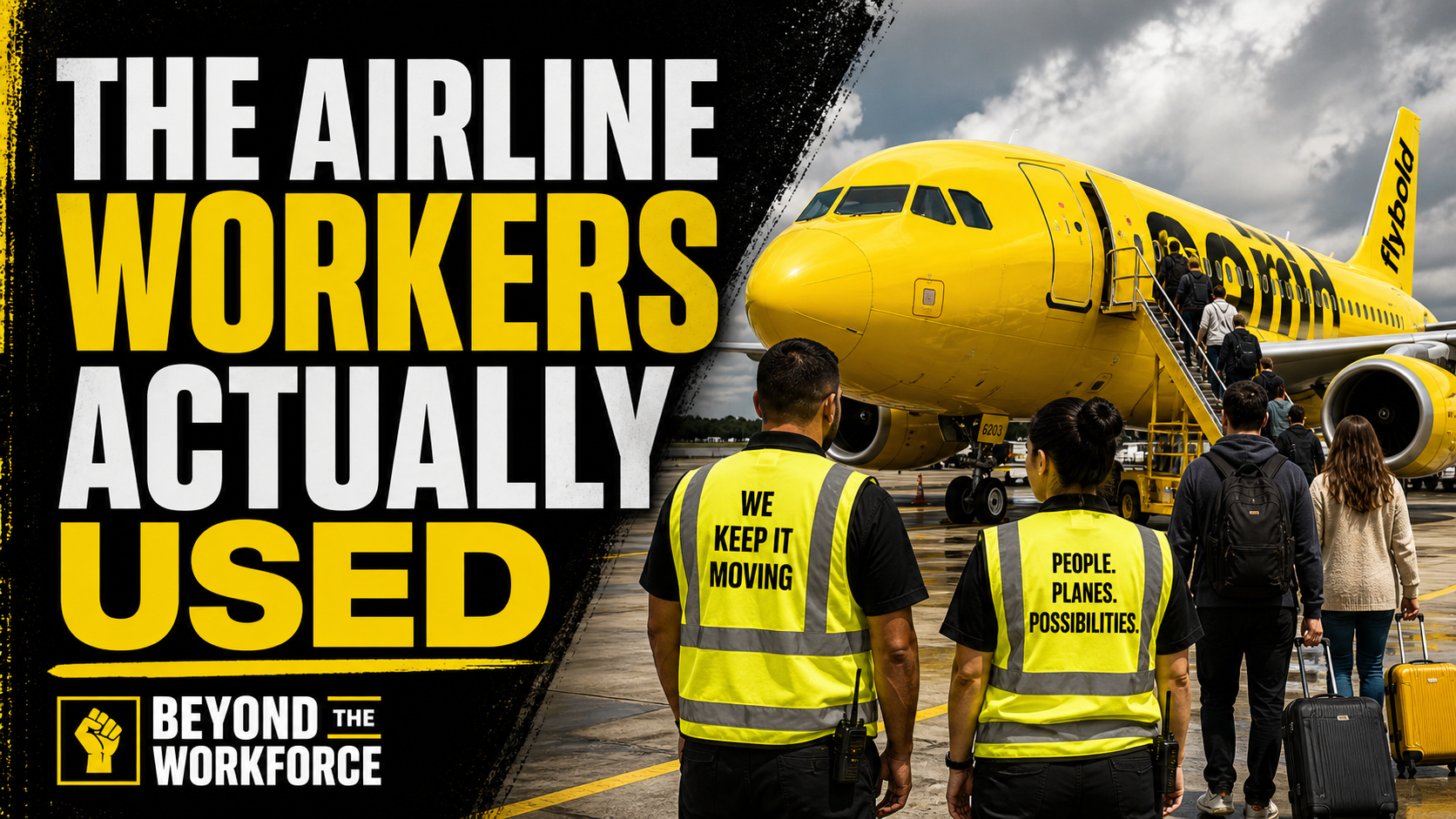
The Airline WOrkers Used
Spirit’s shutdown is being treated like another cheap-airline failure, but that misses the real story. This was never just about uncomfortable seats, baggage fees, or budget travel jokes. Spirit was one of the few remaining pressure valves in an economy where workers are being priced out of the cities they serve, forced to chase jobs across state lines, and expected to absorb every failure from Washington, Wall Street, and the fuel market. This article breaks down how a low-cost airline became working-class infrastructure, how government decisions helped box it in, how fuel shocks finished the job, and why the people who will pay the highest price are not the executives, politicians, or pundits, but the workers who needed Spirit to keep moving.